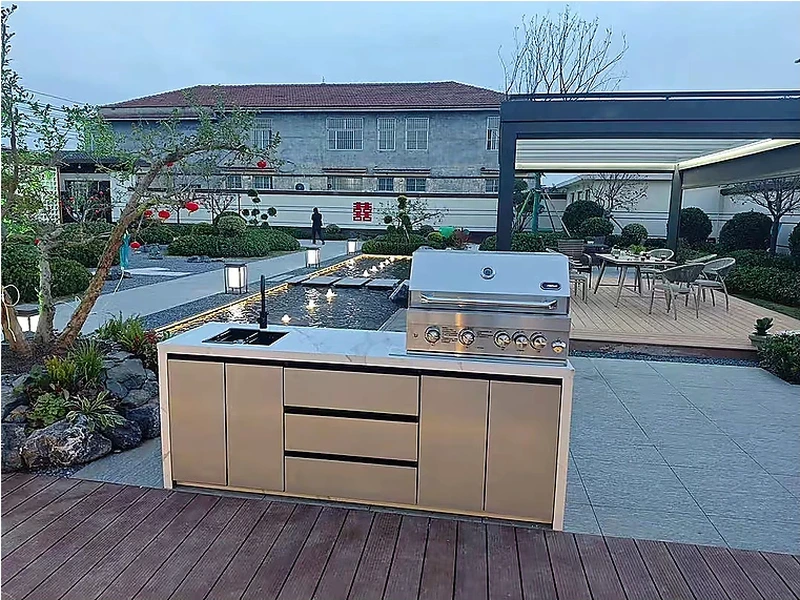
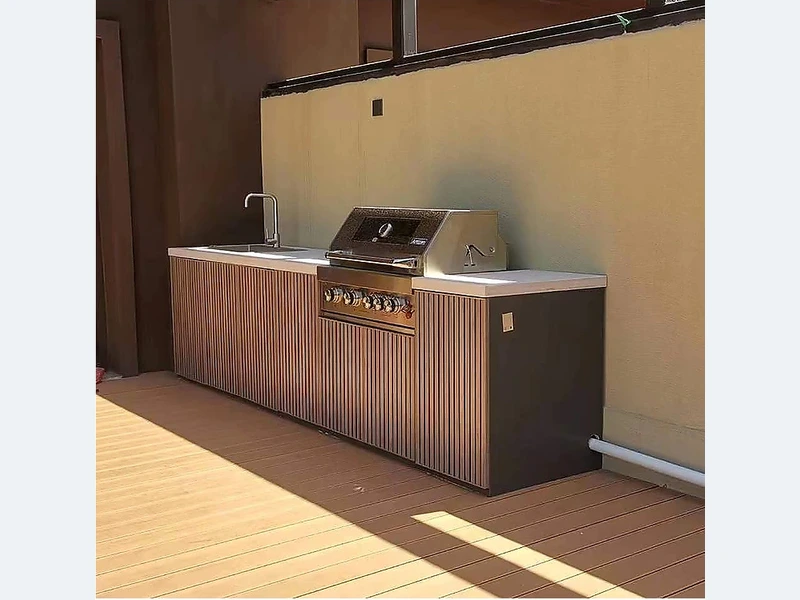
Short answer: 304 stainless steel is widely used for outdoor kitchens in moderate environments, while 316 adds molybdenum and generally offers better resistance to pitting and crevice corrosion in chloride exposure. Coastal salt, pool chemicals, cleaning products, shelter, drainage, finish and maintenance should determine the specification. Neither grade is maintenance-free or universally corrosion-proof.
For project procurement, avoid a quotation that says only “stainless steel.” Require the grade, thickness, finish and component scope in writing. Cabinet bodies, doors, fasteners, hinges, drawer slides, handles and worktops may otherwise be supplied to different unstated standards.
| Decision factor | 304 stainless steel | 316 stainless steel |
|---|---|---|
| Typical positioning | Common general-purpose austenitic stainless steel | Austenitic grade with molybdenum for improved resistance in many chloride environments |
| Moderate outdoor exposure | Often considered with suitable finish, detailing and maintenance | May provide additional corrosion margin |
| Coastal or salt exposure | Greater risk of tea staining, pitting or crevice attack | Usually considered more resistant, but not immune |
| Cost | Generally lower material cost | Generally higher material cost |
| Specification | Confirm grade for every exposed component, not only the cabinet door | |
Stainless steel relies on a passive surface layer for corrosion resistance. Chlorides from sea salt, pool environments, de-icing salts or certain cleaners can challenge that layer, especially in sheltered crevices where deposits remain wet. World Stainless provides technical resources on stainless steel corrosion and coastal applications, including guidance that compares 304 and 316 families.
Exposure is site-specific. A covered inland terrace is not the same as an uncovered cabinet facing ocean spray. Ask about distance from the coast, prevailing wind, direct rain, shade, heat, pool chemicals, irrigation spray and cleaning products. Photographs and a written environment description help the manufacturer and project team select a direction.
A poorly detailed 316 cabinet can perform worse than a well-designed and maintained 304 cabinet in a milder location. Important factors include:
An outdoor kitchen combines cabinets, appliances, utilities and finishes. The written schedule should identify cabinet body and door grades, sheet thickness, internal framing, fasteners, hinges, slides, handles and access panels. It should also define the worktop, cut-out support and appliance ventilation.
Provide final appliance model sheets. Grills, refrigerators, sinks and burners have different clearance, ventilation, drainage, gas, power and heat requirements. Do not approve cabinet production from a generic appliance width alone.
304 may be considered when the system is properly detailed, finished, cleaned and protected from aggressive chemicals. Confirm the actual maintenance plan.
Review drainage, ventilation, finish and crevices carefully. The project may benefit from 316, but grade selection should follow the complete exposure assessment.
316 or another corrosion-resistant specification is commonly evaluated. Even then, regular rinsing, compatible cleaners and deposit removal remain important.
Do not assume 316 is sufficient. A materials specialist may need to consider other alloys, coatings or design changes.
ForgeWin’s stainless steel outdoor kitchen cabinet manufacturer page covers custom modules, appliance coordination and project quotation inputs. Require the approved grade and component schedule before production.
Conditions vary, but coastal chloride exposure increases risk. Evaluate salt, wind, shelter, finish, detailing and maintenance before approval.
No. No stainless steel is completely immune. Surface condition, contamination, crevices, chemicals and maintenance still matter.
Mixed specifications are possible, but the complete assembly and metal interfaces should be reviewed.
List grades by component, thickness, finish, weld treatment, fasteners, hardware, worktop, appliance interfaces, cleaning and documentation. Send the project environment and drawings for review.
2026-09-18
2026-09-26
2026-10-04
2026-10-12